When people start YouTube, the hardest part usually isn’t editing, filming, or buying the right equipment.
It’s deciding what to talk about.
Most creators don’t quit because they’re not talented—they quit because they never find a topic they can commit to. They stay stuck in questions like:
- “I’m not sure what niche to pick yet.”
- “Everyone is already doing it better than me.”
- “What if my topic is too boring?”
- “What if I don’t get views?”
And before they realize it, they’ve delayed their start for months.
But here’s the truth:
The creators who last aren’t the ones who chase trends.
They’re the ones who build around a niche that feels like theirs.
Today, we’ll break down a simple way to find a sustainable YouTube niche—one that doesn’t just get traffic, but also helps you build a long-term personal brand.
✅ What Does “Your Own Topic” Really Mean?
A sustainable niche is not just a catchy hook or a trendy topic.
A real niche has four characteristics:
- You genuinely enjoy it
- You can keep talking about it for a long time
- It gets deeper as your experience grows
- It naturally builds your identity and brand over time
In other words:
A sustainable niche is something you can keep exploring.
A branding niche is something that reflects who you are becoming.
Trends come and go.
But your story, values, and journey?
That’s what accumulates—and that’s what builds trust.
✅ The Easiest Way to Find Your YouTube Topic: Analyze Your Jealousy
Here’s a surprisingly powerful shortcut:
Pay attention to the creators you feel jealous of.
Because jealousy is often a signal of hidden desire.
“You Don’t Feel Jealous About Just Anything.”
Think about it:
- You don’t feel jealous of topics you don’t care about.
- You don’t feel jealous of things you believe you can never do.
- You only feel jealousy in areas where you wish you were in the game.
So if you find yourself watching someone and thinking:
“Why are they getting all the attention?”
“I could do that.”
“I hate that I’m not doing that.”
That’s not random.
That’s your brain telling you:
“This is something you want.”
📌 Ask yourself:
- Which creators make me feel envy or frustration?
- Am I jealous of their results—or their lifestyle/work itself?
- What kind of value are they creating that I secretly want to create too?
When you list 3–5 creators like this and look for patterns, you’ll often find your niche hiding in plain sight.
✅ Why “Self-Improvement” Is a Difficult Topic to Succeed With
A lot of people want to build their channel around self-improvement.
- reading
- routines
- productivity
- mindset
- growth
And it makes sense—self-improvement feels meaningful.
But in reality, self-improvement is one of the hardest niches to grow in, because:
People don’t just watch self-improvement for inspiration.
They watch it because they want proof.
Most viewers follow self-improvement creators because they believe:
- “This person knows what they’re doing.”
- “This person achieved something I want.”
- “If I follow them, I’ll improve too.”
So if you don’t have clear direction, a clear transformation, or a clear story,
your content can easily feel vague—and struggle to stand out.
✅ The Solution: Make Self-Improvement Sharper and More Specific
The problem isn’t self-improvement itself.
The problem is that it’s too broad.
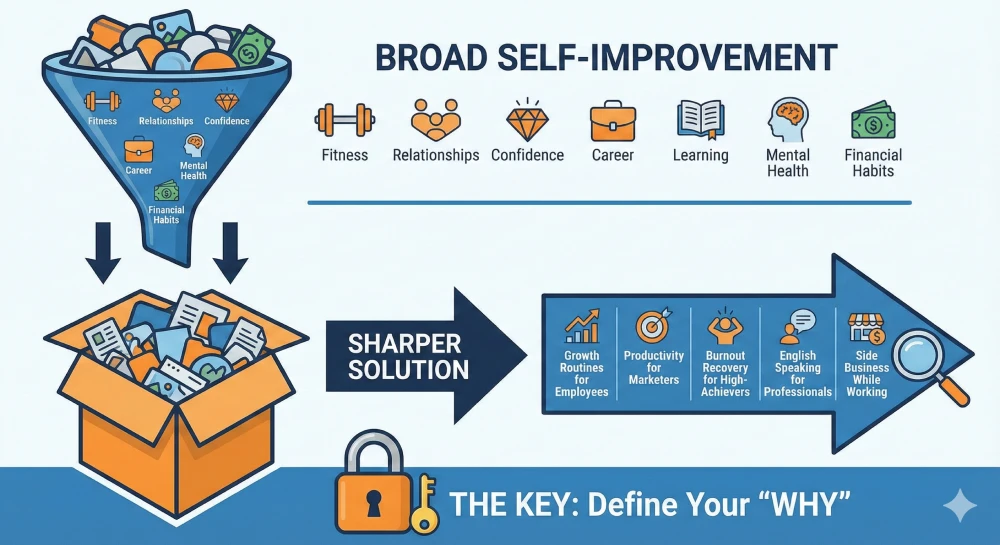
Self-improvement can include:
- fitness
- relationships
- confidence
- career
- learning
- mental health
- financial habits
So when someone says, “I’m doing self-improvement content,”
they’re often competing in a category that’s too wide to own.
Instead, you need one sharp keyword that gives you identity.
For example:
- Growth routines for full-time employees
- Productivity for marketers or creators
- Burnout recovery for high-achievers
- English speaking habits for busy professionals
- Building a side business while working full-time
📌 Here’s the key:
If you want to do self-improvement content,
you need to dig into why you’re improving.
Once you go deep enough, you’ll find a specific story and angle that only you can tell.
✅ A Practical Framework to Narrow Down Your YouTube Topic
If you’re stuck deciding your niche, here’s a simple and realistic process.
Step 1) Who can you help the most?
- What problems have you already lived through?
- Where do you naturally have experience?
- What do people ask you about often?
Step 2) What result do those people want?
- What transformation are they seeking?
- What pain are they trying to solve?
- What do they want to become?
Step 3) Study reference creators
- Who is already doing well in this niche?
- What type of content do people respond to most?
- How do they structure their content?
- What would your version look like?
Step 4) Write down why you want to talk about it
This is the step most people skip—and it’s the reason they quit.
Because a niche is not just content.
A niche is the belief you’re willing to repeat for years.

✅ How to Keep Going Even When Views Are Low
Every creator struggles with numbers:
- views
- subscriber count
- comments
- engagement
But the most important metric isn’t volume.
It’s meaning.
If 100 people watch your video, and 10 of them think:
“I want to watch more of this creator,”
you already have something valuable.
Even small numbers matter when the right people are watching.
If You Keep Delaying, Remember This: It’s Not “Can I Start?” It’s “How Do I Start Well?”
Most people ask:
❌ “What if I can’t start?”
❌ “What if I fail?”
❌ “What if I’m not good enough?”
But successful creators ask:
✅ “How can I start in a way I can sustain?”
✅ “What’s the simplest system I can repeat?”
✅ “How do I improve with every upload?”
Once your question changes, your results change.
✅ How to Use AI Studios to Execute Your Topic Faster (One Practical Section)
Even when people find the right niche, many still don’t start.
Not because they lack ideas—
but because they hit one wall:
The wall of time and quality.
They know what they want to say, but:
- production takes too long,
- filming feels exhausting,
- editing drains their energy,
- and consistency becomes impossible.
This is where AI Studios can help—not by replacing your creativity, but by helping you build a repeatable routine.
A practical way to use it:
- Write a script based on your topic (your insights, your voice)
- Use AI Presenter or templates to turn it into a video
- Publish consistently without filming
If you structure your content into categories like:
- Traffic content (to bring people in)
- Depth content (to build loyalty)
- Sales content (to monetize later)
…you can reuse one message in multiple formats and build consistency faster.
📌 The point of the tool is simple:
Don’t let your niche stay as an idea.
Turn it into a routine you can actually execute.
.webp)
✅ FAQ (Frequently Asked Questions)
Q1. I’ve chosen my niche, but creating content still feels overwhelming. How do I actually start?
A. Many people stop after finding their topic because they hit the same wall: time and quality pressure. Instead of trying to make perfect videos from day one, focus on building a repeatable routine—such as script → template-based video → publish. Using tools like AI Studios can reduce the burden of filming and editing, making it easier to stay consistent.
Q2. What’s the most efficient way to use AI Studios for content creation?
A. A practical workflow is: write a script first → turn it into a video using AI Presenter or templates → publish consistently without filming. It also helps to structure your content into three categories:
- Traffic content (to attract new viewers)
- Depth content (to build trust and loyalty)
- Sales content (to connect with monetization later)
This way, you can reuse one message across multiple formats and produce content more efficiently.
Q3. Will using AI tools make my content feel less personal or “less like me”?
A. Not necessarily. Your content’s identity comes from your topic, voice, and message, not the tool. AI Studios doesn’t replace creativity—it helps you execute faster. As long as your scripts reflect your own experience and perspective, using AI to streamline production can actually help you stay consistent and maintain a stronger, more recognizable brand tone over time.